
The traditional Income Statement is a vital financial tool, showing your company's net income from core operations. But in today's complex business world, it often tells only part of the story.
To get a truly complete view of your company’s financial health and value, you need to understand and use the comprehensive income statement.
As your partners in streamlined accounting, Accubooks Plus is here to break down this essential financial report and explain why it's crucial for management, investors, and anyone who wants to see the big financial picture.
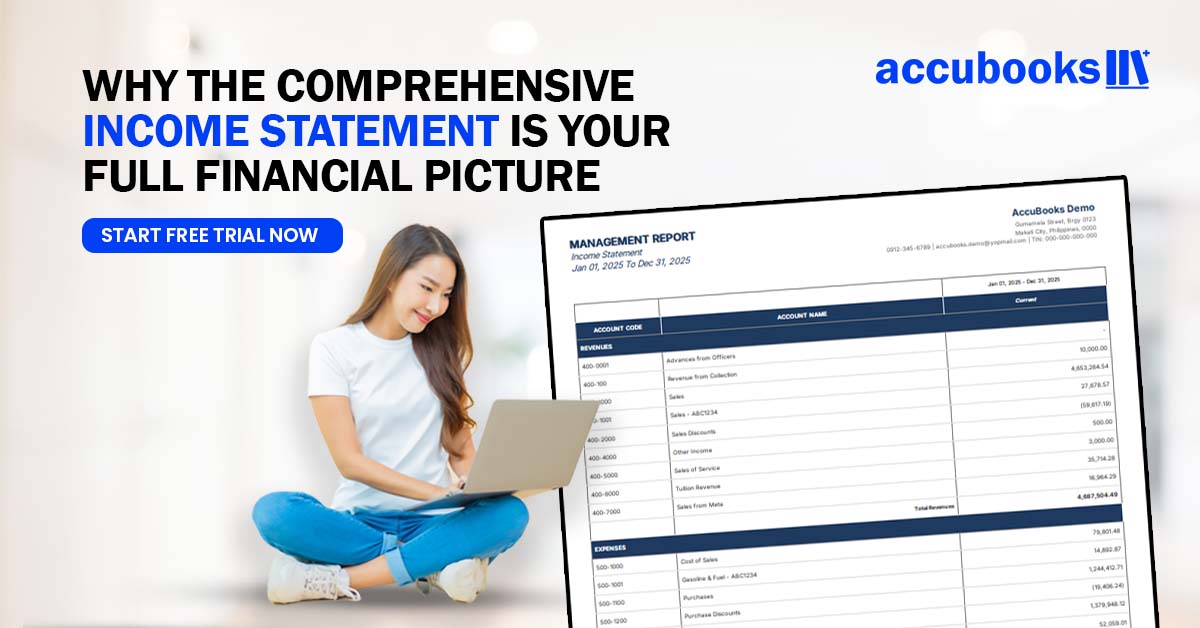
What Exactly is a Comprehensive Income Statement?
The comprehensive income statement is a key financial document that reports all non-owner changes in equity during a specific period. Put simply, it’s the sum of two major components:
Net Income (or Net Loss): This is your traditional "bottom line" from the standard income statement—revenue minus expenses, including taxes. This reflects the profit/loss from your day-to-day operations.
Other Comprehensive Income (OCI): This is the critical, often-missed element. OCI includes gains and losses that affect your company's value but have not yet been "realized" through a cash transaction. These items bypass the traditional income statement and are reported directly in equity.
Comprehensive Income = Net Income + Other Comprehensive Income (OCI)
The Benefits of Using a Comprehensive Income Statement
Moving beyond net income provides distinct advantages for a business owner or stakeholder:
A Truer Picture of Financial Health: By including OCI, the statement shows how market movements and non-operating factors are influencing the total value of your business, offering a clearer view than net income alone.
Better Investor Insights: Potential investors use this statement to gauge the full risk and reward profile of a company, assessing how external market factors impact its financial standing.
Enhanced Risk Management: It highlights potential volatility from foreign exchange rates, investment fluctuations, and hedging activities, allowing management to better assess and mitigate risk.
Compliance with Accounting Standards: Both U.S. GAAP and IFRS require the disclosure of comprehensive income, often allowing presentation either in a single statement or as two separate, but consecutive, statements (Income Statement followed by a Statement of Comprehensive Income).
Accubooks Plus: Helping You See the Full Picture
Understanding the nuances of the comprehensive income statement is essential for strategic decision-making and accurate financial reporting.
At Accubooks Plus, we ensure your financial statements are not only compliant but also provide the deep insights you need to manage your business effectively. Our expert accountants can help you prepare, analyze, and interpret all components of your financial reports, so you’re always viewing your finances with clarity and precision.
Ready to gain a more complete understanding of your company's true value?
Leave a comment